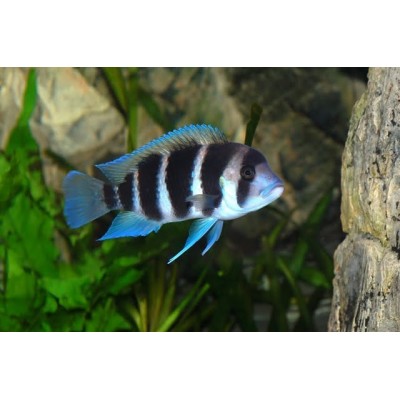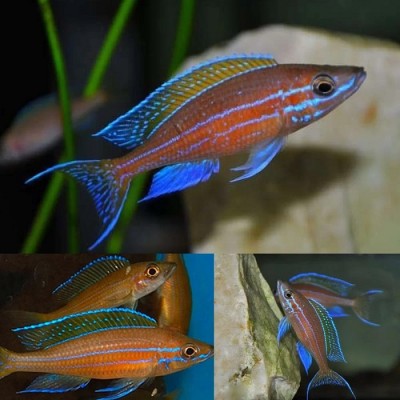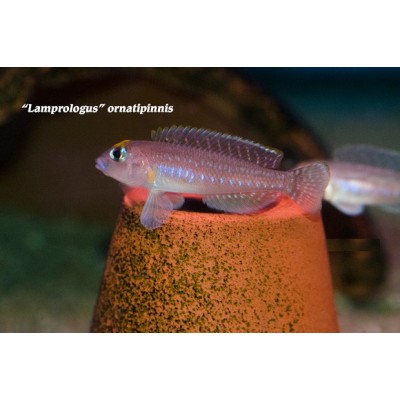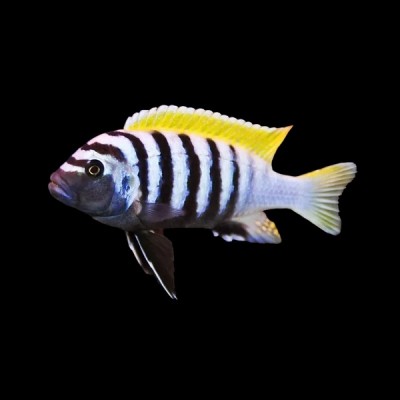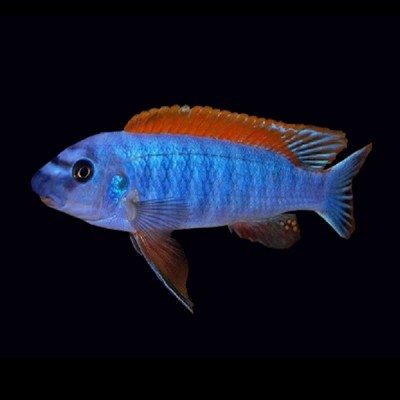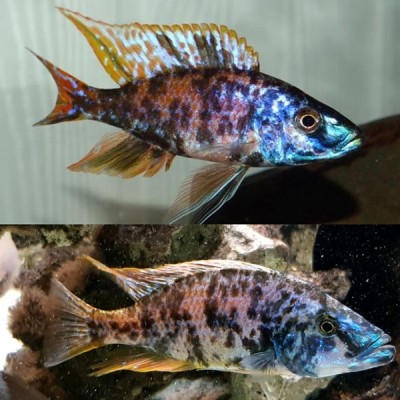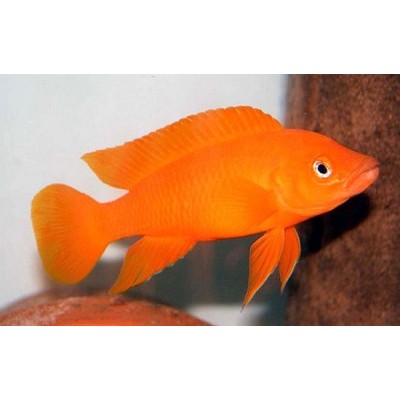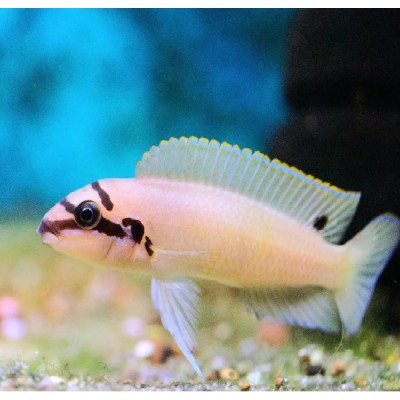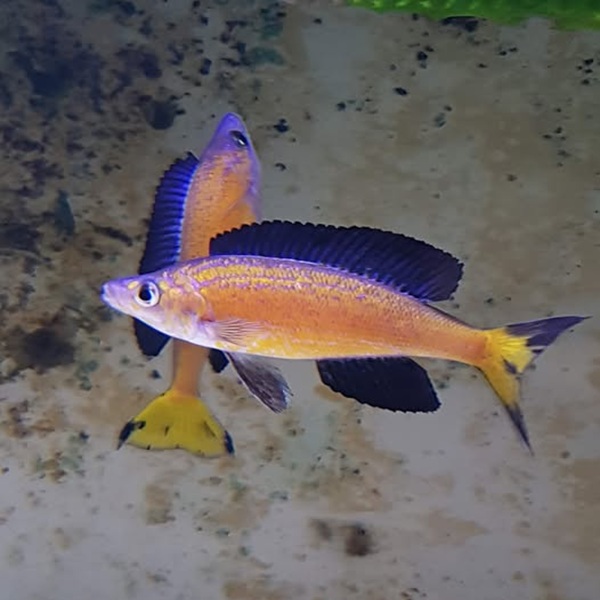
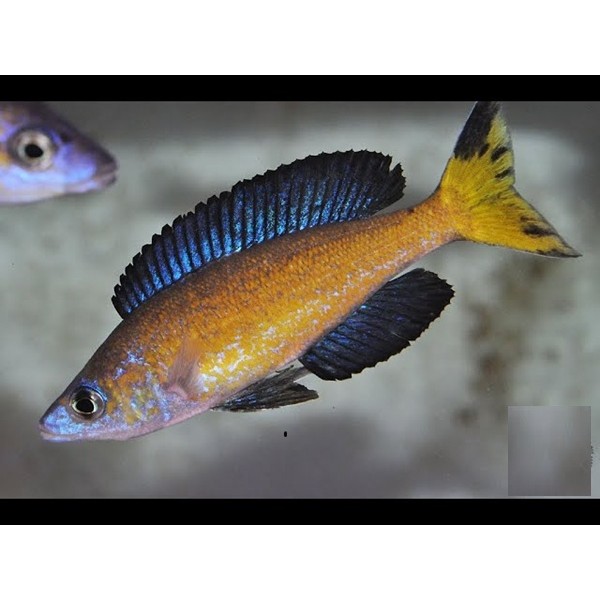
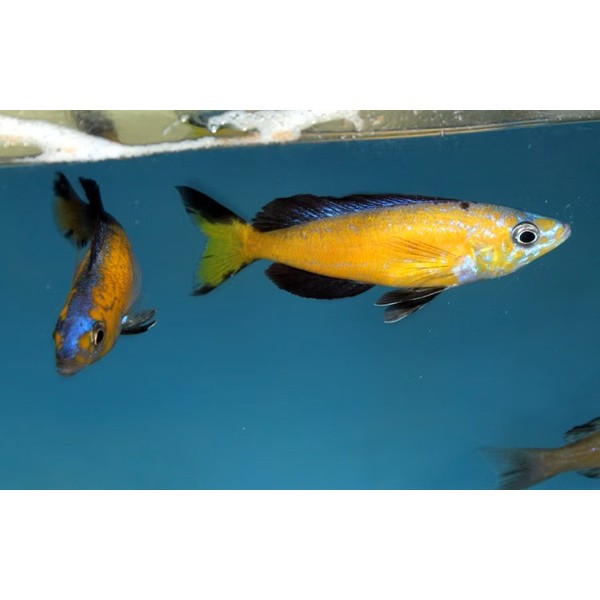


NOTE: Fish Pictures we shown in our website are Reference Images
Shipping time: Orders will be packed and shipped within 2-5 working days after confirmation (as live fish require Quarentine to Ensure Safe Delivery)
Delivery Time: Courier (Home Delivery) Tamilnadu, Pondy, Bangalore 1-2 Working Days after shipping
Courier (Home Delivery) Rest of India 2-5Working Days after Shipping
Train, Bus or Parcel Service For All over India : 1 - 3 Working Days after Shipping
Discounts: Coupon Code Available in HomePage use it while checkout the Cart
NOTE : Please note that males under 4" may not show much color, but they typically develop a tremendous amount once they settle into their permanent tank.
The name of this race of C. microlepidotus comes from the name of the area where it was first caught.
Distribution area
This variety of C. microlepidotus is found in the Bemba (or Pemba) region of the northern Congo coast.
Appearance
These cichlids are polygamous; the females mouth-rear the eggs. Their total length reaches up to 11 cm. Females are slightly smaller. Sexual dichromatism is striking. Males typically have more attractively colored fins.
Especially if they are blue-black or yellow. Cyprichromis microlepidotus is one of many species in Lake Tanganyika that has a large number of color morphs. Since the species is generally quite sedentary (meaning it does not exhibit significant horizontal movements), it is possible that separation and subsequent isolation may have led to genetic changes leading to the development of geographic color forms. Such geographic variants are usually easily differentiated.
The body is elongated and spindle-shaped. The straight mouth can protrude far forward. The upper and lower jaws have multiple rows of conical teeth. Cyprichromis microlepidotus has tiny scales along the longitudinal axis of the body and, because of these, can be easily differentiated from other scientifically described members of this genus. All other species have 39-41 scales along the longitudinal axis of the body, compared to the tiny 63-71 scales of Cyprichromis microlepidotus. Cyprichromis pavo can also be differentiated by its pointed and slightly elongated pelvic fins, extending to the area of the stiff rays of its anal fin. The "Kasai" race has dark spots on a yellow background. Yellow pigmentation is found on the back and snout.
Gender differences
Sexual dimorphism is pronounced. Males typically have more attractively colored fins.
Biotope
This cichlid lives at depths of 5 to 30 meters in open water close to large rocks. It is usually found in relatively large schools, with females and young males in the center, and adult males swimming at the edges, trying to attract females ready to spawn. The fish in the school are grouped closely together, and sometimes in shallow water, Paracyprichromis brieni can be found alongside Cyprichromis microlepidotus.
Contents
The aquarium should contain open water areas and raised sections to give the interior a natural feel and delineate territories. The bottom should be made of fine to medium river sand, not too light. Plants do not grow in this species' natural habitats, although there is no reason not to add a few to liven up the aquarium's aesthetics. Cyprichromis spp. will not dig up or nibble plants. The aquarium floor area should be at least 150 cm x 50 cm, so that these graceful open-water cichlids do not feel overly crowded. Cyprichromis microlepidotus should not be kept in pairs; rather, successful breeding requires groups of at least 10 to 15 fish. Males can comprise more than a third of the group. Cyprichromis spp. coexist well in aquariums with other lake cichlids. Since they primarily live in open water and do not compete with lithophilic cichlids or benthic species, ideal tankmates include bottom-dwelling Xenotilapia species, such as Grammatotria lemairii, Lestradea perspicax, Ectodus descampsi, Cardiopharynx schoutedeni, or similar Paracyprichromis spp. The key is to provide them with a sufficiently sized aquarium. Some aquarists successfully house them with herbivorous Petrochromis and Tropheus, and this is sometimes recommended. However, keeping herbivorous and planktivorous fish together is not practical. If the aquarium has a small rocky area, small Lamprologini can be used as tankmates. Food: Artemia, mosquito larvae, Cyclops, Daphnia, and flake food.
Water parameters
Lake Tanganyika cichlids are recommended to be kept in an aquarium with water pH between 7.5 and 8.8. The use of driftwood and peat fibers for decorative purposes is not recommended. Shell rock and marble are often used to stabilize the pH. For more information on pH, see Sergey Anikshtein's article " pH and Buffer ." The lake's water is predominantly magnesium hardness, so breeders sometimes add magnesium sulfate. The following pH values are acceptable for all lake cichlids: GH: 15-30, KH: 5-15. When keeping Lake Tanganyika cichlids, the water temperature should be maintained between 24-27°C. Higher pH values are unacceptable, especially for long periods. Regular aeration and filtration of water is required, as well as regular, at least once a week, replacement of 10-20% of the water in the aquarium with fresh water or organization of flow-through water changes.
Nutrition
Cyprichromis microlepidotus continuously feeds on plankton. This feeding behavior can be easily observed both in the wild and in an aquarium. The fish rapidly move their extendable mouth back and forth, collecting mobile, small prey. In the wild, their diet consists of crustaceans and phytoplankton. Therefore, feeding cyclops and other crustaceans in captivity is naturally preferable.
Breeding
Although males exhibit territorial behavior, intraspecific aggression consists primarily of posture displays and the expulsion of competitors from their territory. Fights resulting in injury generally do not occur. Intraspecific aggression can be reduced by housing large numbers of adult males together, as this helps distribute conflicts. In a 400-450 liter aquarium, a group of 4-6 males and 12-15 females is optimal. Sexually mature males defend their territory against other males of their species. If a female is ready to spawn in the aquarium, the male begins courtship. The mating ritual consists of spreading and rapidly vibrating the fins and soft rays of the dorsal and anal fins. Sometimes the pelvic fins (and even the caudal fin) also participate in the dance. The yellow patches of the pelvic fins attract females. When the female approaches the male's pelvic fins, he releases sperm. Before spawning, the female releases her eggs directly into the water and takes them into her mouth. This fascinating fertilization process is repeated several times. Females stand upside down in the water while spawning. The eggs gradually sink, while the female slowly moves back and forth. Finally, when the eggs are within reach, the female opens her capacious mouth and captures the eggs. The eggs are subsequently fertilized directly in the mouth. Several different males can fertilize the eggs. The female incubates the eggs for approximately 3.5 weeks. During this time, she continues to feed on small prey. A spawn typically consists of 5-15 fry. Young fish can be fed Artemia nauplii and small cyclops.
- Stock: 2
- Model: IMPORTED F1
- SKU: 1-3 DAY SHIP
- UPC: (1 PIECE)